
Evaluating High School QB Recruits Today
High School Football, Quarterback Recruiting
How High School Quarterback Recruits Are Evaluated in the Modern Era
The days of a college coach discovering a quarterback from a grainy game tape are long gone. Today’s high school signal callers are evaluated through a sophisticated blend of data, film, live events, and off‑field intangibles that make the recruiting process more competitive than ever.
From Friday Nights to Full-Time Evaluation
In the modern era, a quarterback’s performance on Friday nights is just the starting point. College staffs operate more like scouting departments in the NFL, building detailed profiles on prospects as early as middle school. Every throw, decision, and interaction can become part of a recruit’s evaluation file, accessible with a few taps on a tablet or phone.
Technology has made it easier for quarterbacks to be seen, but it has also raised the bar. Coaches can compare a recruit not just to local competition, but to hundreds of peers nationwide, all through standardized video, testing numbers, and live-event performance. The result is a process that is more transparent, more data-driven, and more demanding than ever before.
The Foundation: Physical Tools and Measurables
College programs still start with the basics: size, arm strength, and athleticism. While not every successful quarterback is 6'4", measurable traits help coaches project how a player will translate to the next level, especially against faster, stronger defenses. Verified height, weight, and hand size from camps or combines carry more weight than self-reported numbers on social media profiles.
Size and frame: Can the quarterback withstand college-level hits and grow into a college strength program?
Arm talent: Velocity, touch, and the ability to drive the ball outside the numbers and down the field.
Mobility: Functional athleticism in and out of the pocket, short-area quickness, and the capacity to extend plays.
Timed testing like the 40-yard dash, shuttle, and vertical jump are part of the picture, but coaches emphasize how athletic traits show up on film. A quarterback who navigates the pocket, escapes pressure, and throws accurately on the move often stands out more than one with impressive but isolated testing numbers.
Film Study: Decision-Making, Accuracy, and Processing Speed
Hudl and similar platforms have transformed how quarterbacks are evaluated. Coaches can watch every snap of a season, not just highlight plays. They study how a recruit performs on third down, in the red zone, and late in tight games. The focus is on repeatable traits, not one spectacular throw clipped for social media.
Accuracy and ball placement: Are completions thrown to spots where receivers can run after the catch and avoid big hits?
Processing and anticipation: Does the quarterback throw receivers open, or wait until they are clearly uncovered?
Command of the offense: Pre-snap checks, protection adjustments, and comfort operating different tempos and concepts.
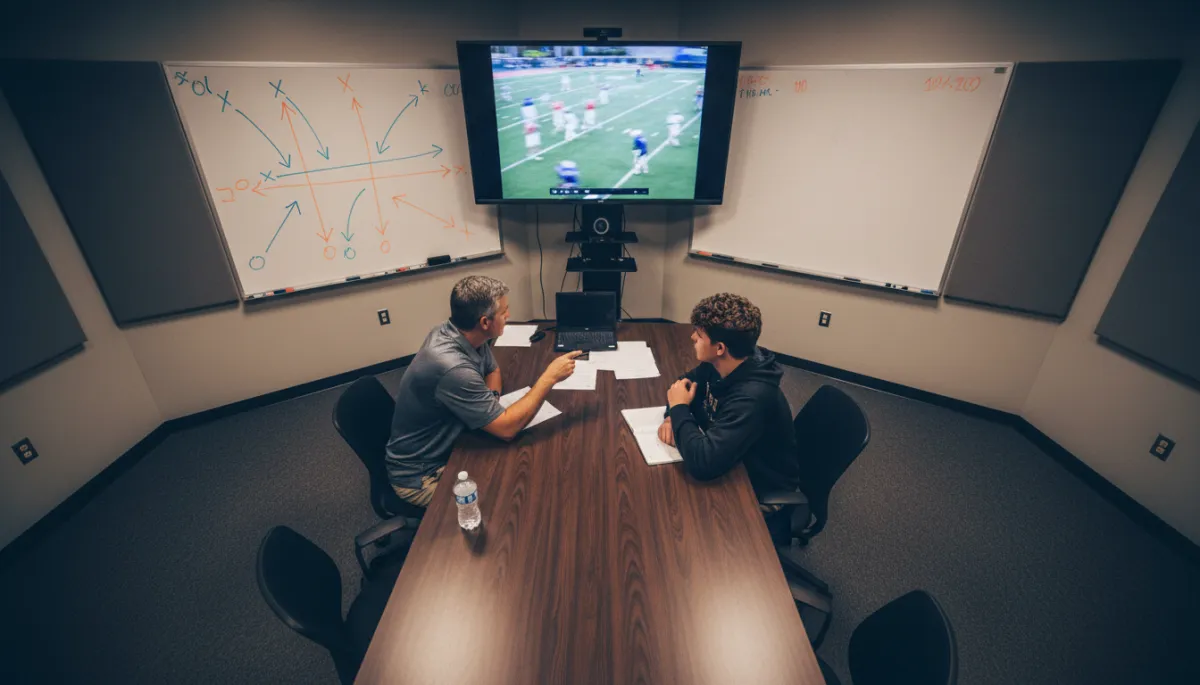
Detailed film review reveals how a quarterback thinks, not just how far he throws.
Context also matters. Recruiters consider the offensive system, the quality of competition, and the support cast around the quarterback. A prospect who demonstrates poise behind a shaky offensive line or elevates a young receiving corps can earn extra respect, even if the stats are modest compared with high-powered spread offenses elsewhere.
Camps, Combines, and 7-on-7: The Live Evaluation Piece
Offseason events have become central to modern quarterback evaluation. College camps, regional showcases, and 7-on-7 tournaments give coaches a chance to see how a recruit throws in person, competes against top talent, and responds to coaching. These environments strip away some of the advantages or limitations of a high school scheme and put quarterbacks side by side for direct comparison.
At these events, evaluators watch mechanics, release quickness, footwork, and consistency from rep to rep. They also pay close attention to body language: how a quarterback handles a missed throw, interacts with teammates, and takes feedback from coaches in real time. A strong camp performance can validate what coaches see on film or raise new questions they want answered with more evaluation.
Intangibles: Leadership, Football IQ, and Character
More than any other position, quarterback is about trust. Coaches want to know who they are handing the keys of their offense to, both on and off the field. That is why intangibles have become a major pillar of modern evaluation. A slightly less gifted passer with elite leadership and work habits can be more attractive than a big-armed prospect who lacks discipline or maturity.
Leadership presence: Do teammates naturally follow him? Is he vocal when needed and steady under pressure?
Football IQ: Understanding coverages, fronts, and situational football, often gauged through whiteboard sessions and playbook quizzes.
Off-field character: Academic performance, social media behavior, and feedback from teachers, counselors, and community members.
Many programs now involve sports psychologists, academic advisors, and recruiting staff in the evaluation process. They help assess how a quarterback might handle being away from home, competing for a starting job, and representing the program publicly. In the modern era, a recruit’s reputation can travel as fast as his highlight tape, for better or worse.
Analytics and the Rise of Data-Driven Recruiting
Advanced statistics have quietly reshaped how quarterbacks are compared. Beyond passing yards and touchdowns, staffs look at completion percentage over expected, yards per attempt, red-zone efficiency, and turnover-worthy plays. Some programs track ball velocity and spin rate with wearable technology, building a more objective view of a quarterback’s physical ceiling and consistency.
Analytics do not replace traditional scouting, but they do help confirm or challenge first impressions. A quarterback whose numbers spike on third-and-long or late in games might be viewed as particularly clutch. Another whose production comes mostly on screens and short throws may be flagged as a system product rather than a true field general. In a competitive recruiting landscape, these small edges matter.
Social Media, Branding, and Communication with Coaches
Social media has turned quarterback recruiting into a public stage. Recruits share highlights, training clips, and visit photos in real time. Coaches monitor not only the content but the tone: humility versus entitlement, team focus versus self-promotion. A thoughtful, consistent online presence can reinforce the impression of a mature leader; careless posts can quickly cool interest from major programs.
Direct communication also plays a role. Phone calls, text messages, and virtual meetings give staffs a chance to gauge personality and coachability. How promptly a quarterback responds, how engaged he is in conversations, and how well he articulates his goals all contribute to the modern evaluation picture. In many ways, recruits are interviewing for a multi-year partnership, not just a roster spot.
The Modern Quarterback Profile: A Holistic View
When a college staff sits down to decide whether to offer a high school quarterback, they are weighing far more than a stat line or a single camp performance. They are layering physical traits, film study, live-event evaluations, analytics, and character assessments into a single, holistic picture. The modern era has not simplified recruiting; it has made it more comprehensive and demanding for everyone involved.
For aspiring quarterbacks, that reality can feel daunting, but it also offers opportunity. There are more ways than ever to showcase growth, leadership, and competitiveness. Those who embrace the process—on the field, in the classroom, online, and in person—give themselves the best chance to stand out in a crowded, data-rich recruiting landscape and earn the trust of the next coaching staff they hope to lead.
📌 Key Takeaway: Quarterback recruiting now rewards players who develop physically, mentally, and professionally across every area of their lives.
Ready to navigate this process with a clear plan? Book a free one-on-one consultation today to review your film, measurables, and recruiting strategy so you can take the next step with confidence.