
Evaluate Football Program's Scheme Fit for Skills
Football, Player Development, Recruiting
How to Evaluate a Program's Offensive and Defensive Scheme Fit for Your Skill Set
Choosing the right football program is about more than facilities and logos. It’s about finding a system where your skills actually shine. Here’s how to evaluate scheme fit on both sides of the ball so you land in the best situation for your game and your future.
Why Scheme Fit Matters More Than Brand Name
A “big name” program can still be the wrong choice if its schemes don’t align with how you naturally play. Scheme fit affects your playing time, production, development, and how college or pro scouts eventually view you. The right system:
Puts you in positions you already understand and execute well
Highlights your strengths instead of exposing your weaknesses every snap
Gives you clear, repeatable roles that translate to the next level
Step 1: Evaluate a Program’s Offensive Scheme Fit
Start by understanding what the offense actually is, not just what the coaches call it. Watch full games, not just highlight reels, and look for patterns: formations, tempo, and how often different positions touch the ball or are featured in protections and routes.
For Quarterbacks and Skill Players
Quarterbacks: Is it a spread, RPO-heavy attack, or a pro-style system with full-field reads and under-center work? Do they ask the QB to run often, or mainly operate from the pocket? Match this to your arm talent, decision-making, and mobility.
Wide receivers and tight ends: Do they feature multiple-receiver sets, option routes, and vertical shots, or is it a run-first offense where you block more than you catch? Check how many players at your spot record meaningful targets each game.
Running backs: Is the run game zone-based, gap/power, or a mix? Are backs used as receivers and in pass protection? Consider whether your vision, patience, and pass-catching match what they emphasize.
For Offensive Linemen
Offensive linemen should look closely at the run schemes and pass sets. A system that relies heavily on outside zone and screens may favor lighter, more athletic linemen, while a downhill gap scheme leans on bigger, powerful blockers. If you’re technically sound but not a natural sprinter in space, a system that constantly pulls and reaches might not be ideal for you yet.
Step 2: Evaluate a Program’s Defensive Scheme Fit
Defensively, pay attention to fronts, coverages, and how often the staff adjusts based on opponent and situation. The label “4–3” or “3–4” only tells part of the story; your role within those structures is what truly matters.
Front Seven: Defensive Line and Linebackers
Defensive linemen: Are they asked to penetrate gaps and disrupt, or control two gaps and keep linebackers clean? Explosive, twitchy linemen usually thrive in attack-oriented fronts, while longer, powerful players may fit better in read-and-react systems.
Linebackers: Does the scheme emphasize blitzing, coverage, or run fits? Some systems keep linebackers clean and downhill; others demand that they carry receivers vertically or match up with backs in space. Your speed, instincts, and coverage ability should match how they use their linebackers on film.
Secondary: Corners and Safeties
For defensive backs, scheme fit often comes down to coverage philosophy. A press-man program demands different traits than a zone-heavy, pattern-match defense. Ask yourself: are corners usually on an island, or do they get help? Are safeties playing deep halves, rotating late, or living near the box as hybrid defenders? Your range, tackling, and one-on-one skills should align with what you see on their tape.
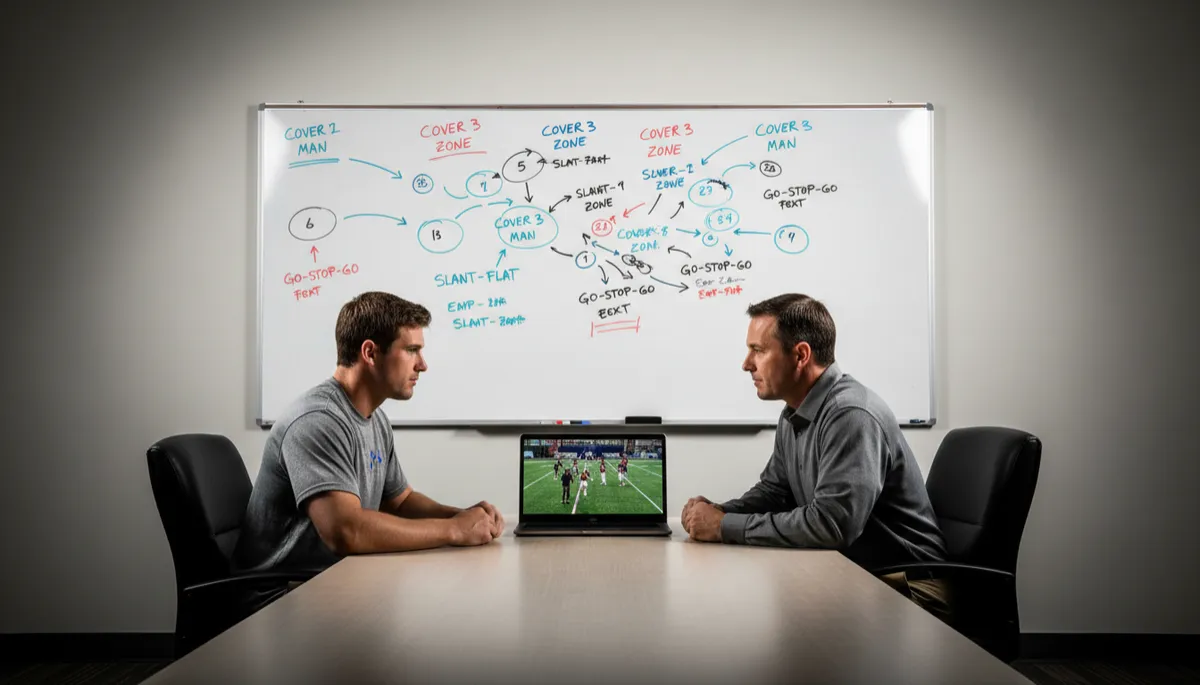
Honest film study with coaches clarifies how your skills translate to their system.
Step 3: Take an Honest Inventory of Your Skill Set
Evaluating a program’s scheme only matters if you’re equally honest about who you are as a player right now. Break your game into specific traits rather than vague labels like “athletic” or “physical.”
Physical tools: Size, speed, strength, quickness, and endurance compared with typical players at your position and level.
Technical skills: Footwork, hand usage, route-running, tackling form, block destruction, ball skills, or throwing mechanics.
Mental traits: Football IQ, ability to learn complex playbooks, comfort making on-field checks, communication, and poise under pressure.
💡 Pro Tip: Ask current coaches and trainers for blunt feedback. Their outside perspective can reveal whether you truly fit a system or just like how it looks on Saturdays.
Step 4: Match Their Roles to Your Reality
Once you understand both the scheme and your own skill set, connect the dots. Watch how players in your position group are used in that program and ask:
“Can I realistically do what that player is being asked to do, at speed, right now?”
“If not, how far away am I, and will this staff help me close that gap?”
In conversations with coaches, go beyond generalities. Ask where they truly see you in their scheme: boundary corner or nickel, field safety or box safety, slot receiver or outside, weak-side or strong-side linebacker. Specific answers reveal how clearly they’ve thought about your fit.
Final Thought: Choose the System That Maximizes Your Ceiling
A great football career is built where talent, work ethic, and scheme meet. When you carefully evaluate a program’s offensive and defensive identity and compare it honestly to your own skill set, you give yourself the best chance to play early, develop consistently, and showcase your abilities to the highest level possible.
🎯 Ready to Get Noticed? Join our free Facebook group for football parents — recruiting education, real wins from real families, and direct guidance from a former zero-star recruit turned ACC & SEC starter. Click here to join the group and start getting your athlete in front of the right eyes.