
College Football Recruiting School for Parents
College Football, Recruiting Education, Parents
What to Expect in Our College Football Recruiting School for Parents
Guided by founder Dr. Kalvin Cline, a former Division I starter in both the ACC and SEC, this recruiting school gives football parents a clear, realistic roadmap through today’s complex recruiting world—from 7th grade all the way to signing day.
Why Today’s Recruiting Game Is Different for Your Son
If you played or followed college football even a few years ago, the recruiting landscape you remember no longer exists. The transfer portal, NIL (Name, Image, Likeness), and new roster limitations have completely reshaped how college coaches build their teams—and how they evaluate high school prospects.
1. How the Transfer Portal Has Changed Recruiting
The NCAA transfer portal now allows college players to move schools more freely, often with immediate eligibility. That means many staffs treat the portal like free agency—filling needs with proven college players before turning to high school recruits. In recent years, more than ten thousand players have entered the portal across divisions, and coaches openly describe it as the “spine” of modern roster building.
For families, this shift is huge: fewer spots are available for high school athletes, timelines are tighter, and coaches are far more selective. Our school explains how portal recruiting and high school recruiting fit together, so you can realistically target the right levels and opportunities for your son.
2. NIL: Opportunity and Reality for Football Families
Since 2021, athletes can earn money from their Name, Image, and Likeness (NIL). NIL has become a recruiting buzzword, but also a source of confusion and unrealistic expectations. Big brands, collectives, and social media markets now factor into where some top recruits sign, and NIL can also influence transfer decisions.
Inside the group, Dr. Cline breaks down what NIL actually looks like for most players, how it varies by level, and how families should think about branding and social media without letting NIL fantasies derail sound recruiting decisions.
3. Roster Limitations and Why Offers Are Scarcer
With scholarship caps and evolving roster rules, coaches must balance high school signees, transfers, and walk-ons within tight numbers. When a staff takes a transfer at your son’s position, that often means one less scholarship for the high school class. Our sessions explain how roster math works at different levels and why “we like you, but we’re full” is more common than ever.
Understanding How College Football Recruiting Works at Every Level
One of the first things parents learn in our school is that Division I, FCS, Division II, Division III, NAIA, and JUCO all recruit differently. Scholarship rules, academic standards, timelines, and evaluation priorities vary widely. We walk you through:
How Power Five and Group of Five programs use rankings, camps, and the portal together
Why FCS and Division II may be more relationship-driven and regional
How DIII and some NAIA schools build “academic plus athletic” packages without traditional athletic scholarships
This big-picture view helps families set appropriate targets and avoid chasing levels that don’t match their son’s current film, measurables, or academic profile.
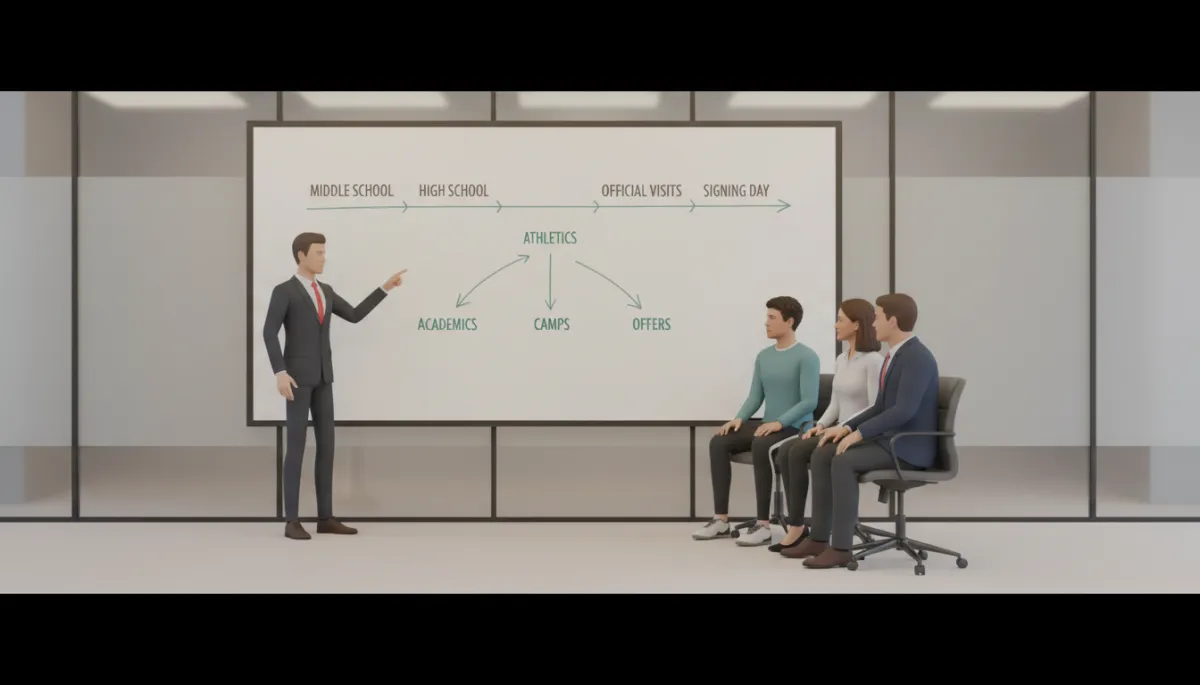
A clear year-by-year plan replaces guesswork and last‑minute scrambling.
Core Skills We Teach Inside the Recruiting School
4. Building Effective Highlight Tapes Coaches Actually Watch
Your son’s highlight tape is often his first impression. We show you how to structure film so coaches see his best plays in the first 30–60 seconds, understand his position, and quickly gauge his speed, size, and football IQ. You’ll learn:
What to include—and what to leave out
How to label plays and add basic context without over-editing
How to update film as your son grows and improves
5. Using Hudl Recruitable Mode the Right Way
Many families have Hudl but don’t fully understand Hudl’s recruitable mode. We walk you through how to:
Set up your son’s profile so coaches can quickly find key information (height, weight, GPA, contact info)
Tag and organize clips to match what coaches look for at each position
Use Hudl links correctly when emailing or DM’ing coaches
6. Reading Recruiting Signals on X (Twitter)
X (formerly Twitter) is still one of the main places coaches and recruits interact publicly. But not every like, retweet, or follow means an offer is coming. Dr. Cline teaches parents and players how to:
Tell the difference between real recruiting interest and generic engagement
Use X to share film, updates, and camp schedules professionally
Avoid red-flag posts that can quietly take your son off a board
7. Evaluating Camps and Showcases Before You Spend
Camps and showcases can open doors—or drain your budget with little return. Our group gives you a framework to judge whether a camp is worth it based on:
Which college staffs will actually be on the field coaching and evaluating
How your son’s current ability and measurables compare to that camp’s typical recruit
Whether it fits into a larger, strategic plan—not just a one-off event
8. Communicating with Coaches with Confidence and Respect
Many families are unsure what to say, when to reach out, or how often to follow up. We provide templates and live examples for:
Initial emails and DMs that include the right information in the right order
How parents should communicate versus what should come directly from the player
How to handle interest, camp invites, offers, and tough conversations respectfully
9. Creating Scholarship Opportunities from Middle School Through Signing Day
Our school is built for families with sons as early as 7th grade all the way to unsigned seniors. Instead of panicking junior year, you’ll follow a step-by-step plan that covers:
What middle school and early high school players should focus on: fundamentals, academics, and athletic development—not rankings
When to start building film, social media presence, and camp exposure
How to keep doors open late for seniors through late camps, showcases, and the right level targets
Why This Recruiting School Matters for Your Family
In a world defined by the transfer portal, NIL, and tight roster numbers, guessing your way through recruiting is no longer an option. Dr. Kalvin Cline’s College Football Recruiting School for Parents replaces confusion with education, strategy, and clarity.
Whether your son is just starting his journey in 7th grade or is an unsigned senior still searching for the right home, this group helps you understand the modern game, avoid costly missteps, and build a realistic, personalized plan to create opportunities at the next level.
📌 Call to Action: Ready to see how this applies to your son’s specific situation? Book a free consultation to review your current recruiting picture, ask questions, and map out your next best steps—before important windows close.